
Darren Chua | Lumyra AI Growth Catalyst | May 2026
Last edition, we named the Web’s Quiet Fork: from B2C to B2B to B2A. That was the external story: how products are being redesigned for agentic consumers. This is the internal story. If B2A is how your organisation faces outward to agents, Human-AI Squads are how you organise inward to build with them.
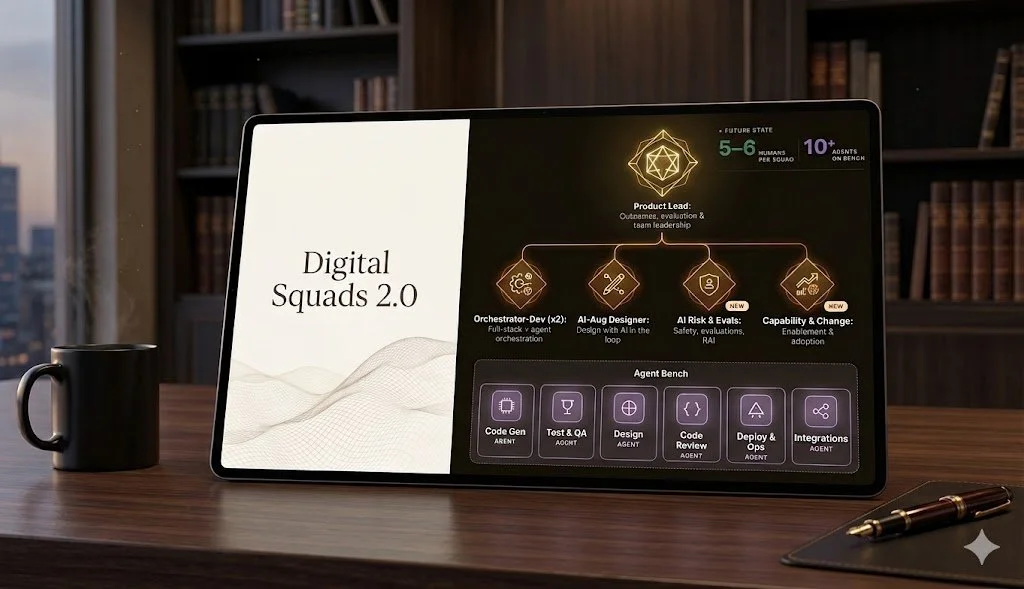
The Big Idea
The Spotify squad model defined a decade of digital delivery. Cross-functional teams of about 10 people (product manager, scrum master, developers, QA, designer) owning a mission and shipping autonomously. It became the template thousands of organisations copied. Now Spotify itself is rewriting it.
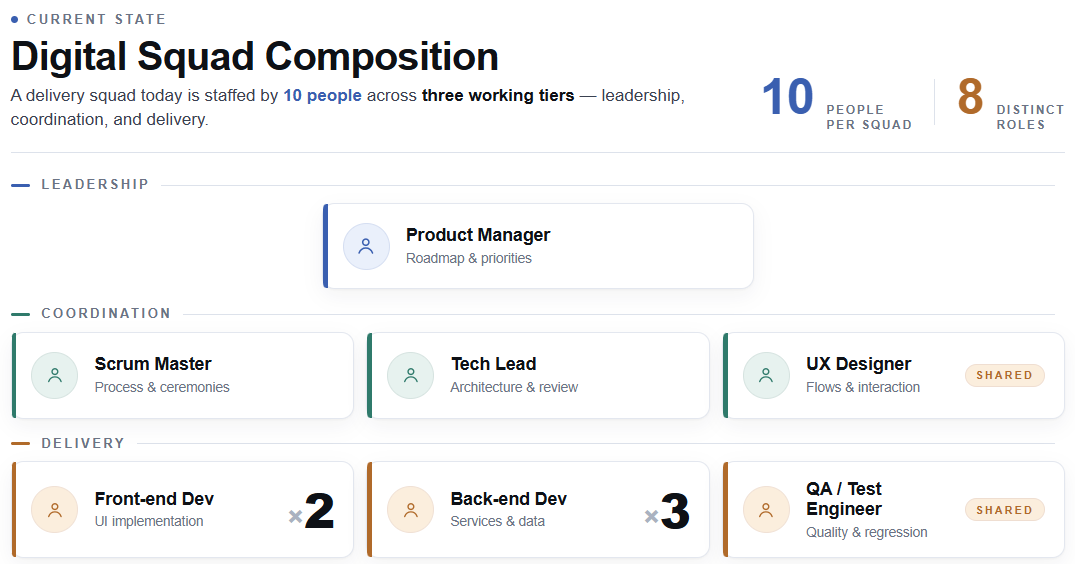
Current state: the classic 10-person digital squad.
Spotify’s top engineers haven’t written a line of code since December 2025. They orchestrate an internal system called "Honk" built on Claude Code, merging over 1,000 pull requests every 10 days (Spotify Engineering, April 2026). At Anthropic, 100% of code is now written by agents. Engineers have shifted entirely to specifying, orchestrating and reviewing (Fortune, January 2026). Gartner predicts that by 2030, 80% of organisations will evolve large software engineering teams into smaller, nimbler teams augmented by AI (Gartner, October 2025).
The 10-person squad is compressing to 5–6 humans augmented by a deep bench of AI agents. The Block and Atlassian downsizings are early signals, but large incumbents, regulated enterprises and public sector organisations will follow on different timelines. Importantly, it’s not a one-to-one roster swap and future digital squads might run multiple design agents, code gen agents, testing, risk management and change agents in parallel. This sharpens the bottleneck; fewer humans, more output to verify and more decisions per person per day.
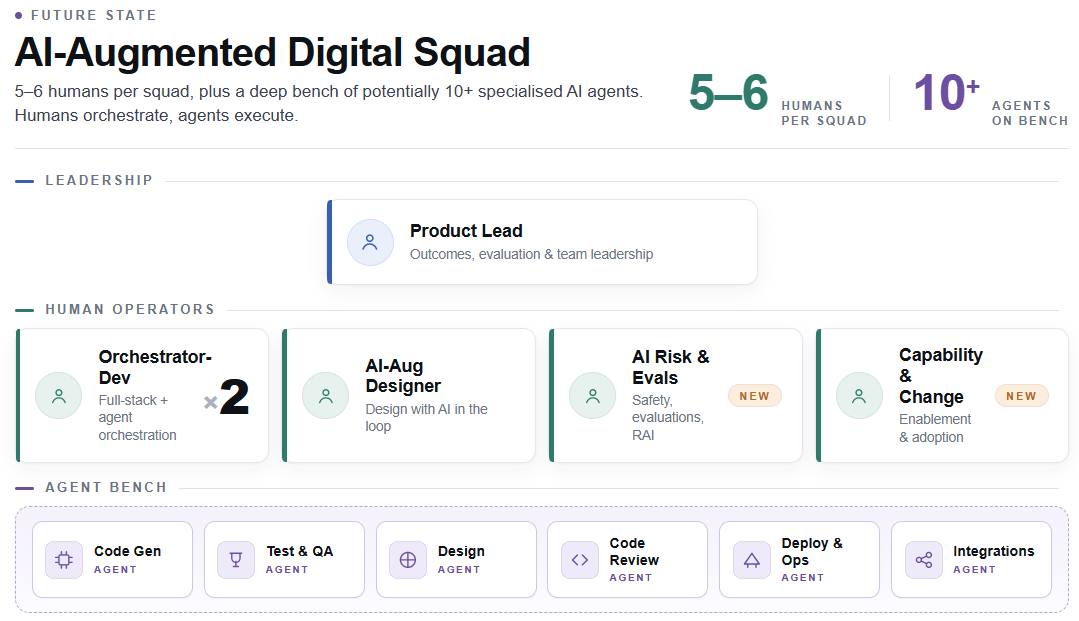
Future state: the AI-augmented squad of 5–6 humans and potentially 10+ specialised agents.
The real story isn’t the shrinking headcount. It’s the shift in what humans do.
The Digital Bottleneck Has Shifted
For a decade, the bottleneck in digital delivery was building things: writing requirements, building architecture, coding, testing, debugging. The entire squad model was purpose-built for that constraint.
Something shifted between December and February. AI agents now handle most of that work, generating code, tests, documentation, even deployment. The hard part has moved downstream: Can you verify and stand behind what agents produce?
AI-generated code introduces 1.7× more issues and requires 91% more review time per pull request (CodeRabbit, March 2026). 62% of security teams are struggling to keep pace with AI-generated code volume, with two-thirds spending more time validating findings than fixing vulnerabilities (ProjectDiscovery, April 2026).
Agents are fast. Evaluation is slow. That asymmetry is the new constraint. Humans are moving from building to specifying and verifying. The spec — not the codebase — becomes the source of truth, and evaluation becomes a critical discipline.
ROI and cost control also become differentially important. If you build everything you can, rather than only what you should, you dilute the return on every AI tool and your people’s focus.
This is not an engineering decision. It’s an organisational design and value-based decision.
The Human Roles That Grow
Here’s the counterintuitive part: in a world of AI-driven acceleration, the functions most likely to grow in headcount and strategic importance are leadership, risk, governance and change. The integrated work of orchestrating agents, managing risk and leading humans through continuous reinvention becomes more complex, not less, as agents do more of the doing.
Agents create categories of risk we haven’t managed before, at vastly greater volume and frequency than human workers ever produced. Yet only 21% of organisations have mature agent governance (Deloitte, 2026), and only about a third have reached governance maturity level 3 or higher (McKinsey, April 2026). The awareness is there. The action isn’t.
Future squads need an AI Risk & Quality Lead who owns eval frameworks and output verification. It needs a Capability & Change Lead because workflows, roles and handoffs are being rewritten continuously. And every developer becomes an Orchestrator-Developer, writing specifications and evaluating outputs rather than writing code.
The World Economic Forum’s Organizational Transformation in the Age of AI report puts it well: organisations that embed governance early avoid fragmentation and scale AI faster. Governance isn’t the brake. It’s the steering (WEF, Jan 2026).
What This Looks Like in Regulated Enterprises
For many organisations in highly regulated environments such as healthcare and financial services, the future squad trajectory is aspirational, not imminent. A nine-month compliance review cycle for any AI-touched workflow doesn’t disappear because agents got faster. Banks under prudential supervision, medical device makers operating under EU MDR or FDA oversight, and insurers preparing for the EU AI Act all face a different curve, one where verification, audit trails and explainability are non-negotiable.
But the underlying shift still applies. The bottleneck still moves from building to verifying, more emphatically because regulated verification is harder. The new roles still emerge, but they must embed compliance, clinical safety or financial risk into the team from day one, not as an external review gate. And the hybrid team challenge still arrives, with the added complexity of explaining agent decisions to regulators who haven’t yet decided what "good" looks like.
Regulated organisations don’t get to skip this shift. They have to design it more carefully, with governance built into the operating model from day one.
From Digital Squads to Hybrid Teams, Everywhere
Here’s my bigger concern: digital squads are just the most visible case of something that will reshape every team in every function.
HBR recently introduced the concept of the "agent manager": leaders responsible for orchestrating how AI agents learn, perform and work safely alongside humans. Salesforce already has people in this role. Just as product managers emerged during the software revolution, agent managers are becoming the connective tissue between strategic intent and autonomous execution (HBR, February 2026).
But the challenge runs deeper than managing agents. Leaders will be managing humans who work alongside agents. That’s a fundamentally different psychological proposition. A squad of 5 humans and potentially 10 or more agents creates conditions no leadership playbook has yet answered. The risk isn’t running out of agents. It’s running out of human capacity to direct, verify and absorb what they produce.
There are three moves every executive team should be making now.
Plan for the growth roles, not just the contractions. The dominant narrative is that AI shrinks teams. That’s only half the story. Agent managers, AI orchestration leads, agentic workflow designers and AI Risk & Quality leads are net-new investments. Workforce planning is a portfolio shift, not a flat headcount cut.
Treat cognitive load as a leading indicator of hybrid team health. The squads burning out fastest aren’t the ones with the most agents. They’re the ones where human review capacity hasn’t scaled with agent output. If you’re not measuring the cognitive load your people are carrying, you’re not managing the system. You’re hoping it holds.
Build agent-manager capability deliberately. It won’t emerge from existing line managers. Managing a hybrid team is a different leadership proposition: setting goals across human and non-human agents, calibrating trust, designing escalation paths, nurturing wellbeing while agents work without rest. This is a capability investment, not a job-title relabelling exercise.
Organisations will get flatter. But they’ll also become significantly more complex. The leaders who treat this as a technology deployment, rather than an organisational redesign, will find themselves managing a system they don’t understand.
Lumyra’s Perspective
The traditional 10-person digital squad will be legacy within 12 to 18 months. Not because people aren’t needed, but because the composition is wrong for what’s coming.
The future squad is smaller, more senior, and organised around disciplines that barely existed a year ago: spec-driven development, eval-driven development, with embedded Responsible AI governance. The organisations that move first won’t just ship faster. They’ll attract the best talent. Senior engineers want high-judgment work. Risk and governance professionals will be in acute demand. And the leaders who learn to manage Human-AI teams — not just AI tools — will gain true competitive advantage that compounds.
The question for every CEO and Chief People Officer is no longer how do we deploy agents? It’s how do we redesign work itself, and do we have the leadership capability to manage what comes next?
Darren Chua is Co-Founder and CEO of Lumyra.ai, an AI strategy & governance advisory firm, and a PhD researcher at the University of Technology Sydney studying human-AI collaboration and governance in high-stakes decision-making.
Previous edition: The Web’s Quiet Fork: From B2C to B2B to B2A
